


How to Fit a Kitchen Worktop

Introduction
Widely used surfaces such as laminate and hardwood can be installed by any kitchen fitter, or by a fairly confident DIYer. It's worth remembering though that fitting a kitchen worktop is an advanced DIY task and any mistakes made during cutting can prove costly.
With this in mind if you are in any doubt, hire a professional kitchen fitter or carpenter to do the job for you.
- Several types of worktop, such as Corian®, Zodiaq® and granite should only be installed by the supplier who will have the necessary cutting and lifting equipment to deal with these specialist materials.
Tools for the Job
To fit a kitchen worktop you will need the following tools;
- Worktop Jig
- Router (with 30mm guide bush and 12.7mm (½in) carbide collet (cutter))
- Jigsaw (with downstroke and upstroke wood blade)
- Biscuit Jointer
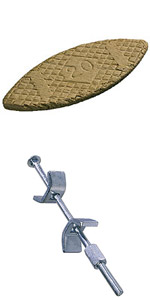
- Size 20 Biscuits (4 per joint)
- Worktop Bolts (3 per joint)
- Electric Drill (with 10mm drill bit)
- 2 Clamps
- 2 Saw Horses
- Measuring Tape
- Pencil
- Masking Tape
- Eye Protection
- Slotted Brackets
- Silicone Sealant

Top Tips
- Accurately measure the walls along which worktop is to be mounted and decide the layout of any corner joints.
- Joints should be placed as far from sinks and hob cutouts as possible.
- To avoid using ugly jointing strips, joints should be arranged as a simple mitre or as butt joints. The latter of these is preferred for strength and appearance and requires a worktop jig for cutting.

- Each joint should be secured with three worktop bolts and 4 biscuit joints.
- Use the worktop jig and router to cut complementary male and female ends for each corner. Follow the instructions and remember to seal the cut edge of each piece.
- Only after joints have been cut and checked for a snug fit should worktops be cut to length.
- Aim to lay worktop on top of base units such that it projects over the front edge of the carcass by a consistent measurement, usually 20mm (¾in). This allows for the doors to be attached and retain a small overhang of a few millimetres.
- This may require the depth of worktops to be trimmed as well as the length.
- Unless you’re lucky enough to have a perfectly square room, you may also need to trim worktop edges so they follows the contours of each wall to within 3mm (⅛in). It may help to make a cardboard template.
- When cutting worktop to size, mark your line in pencil on a strip of masking tape to make it easier to see. Cut with a jigsaw from the front profiled edge to the back, unfinished edge. For a right-handed person to cut a right-hand edge, the worktop should be cut good side up, with a downstroke blade to avoid fragmenting the good surface. To cut a left-hand edge, the worktop should be turned upside-down and an upstroke blade should be used. (This procedure should be reversed for a left-handed person).
- To cut holes for sinks (and hobs) if you have not been supplied with a template, turn the sink upside down in the desired position on the worktop and draw around the edge with a pencil. Then mark a line 10mm (⅜in) inside the original line to create a supporting ‘lip’ for the sink to sit on. Drill a 10mm (⅜in) hole reasonably close to the inside line and then use the jigsaw to cut out the remaining shape, creating rounded corners to avoid splits.
- Remember to apply sealant to the underside edge of sinks and appliances during installation to prevent water becoming trapped and damaging the worktop.
- Any straight run of worktop must be supported by a vertical strut every 600mm (2ft). Where two appliances are sited next to each other, a supporting panel must be positioned between them.
- The worktop should be secured to base units via slotted stretcher brackets. Lengths of worktop not resting on base units should be supported via horizontal battens screwed to the wall and/or vertical supports (either flat panels or tubular worktop legs).
Further information and useful links
- Find a Kitchen Worktop supplier near you
- Find a Kitchen Planner near you
- Find a Kitchen Sinks & Taps supplier near you
- Find a Kitchen Fitter near you
- Find a Carpenter near you
Site Pages
Featured Articles