


Carpet Fitting

Introduction
Several additional accessories are required to properly fit a carpet and these will need to be budgeted for. Indeed, if you plan to have your carpet fitted professionally, the total cost of all carpet, underlay, accessories and fitting is likely to be approximately double the cost of the carpet alone.
This guide is intended for a fitted carpet that is supplied on a roll. Carpet tiles should be fitted as per vinyl tiles, and require no underlay as they are usually self-adhesive, sticking directly to the sub-floor surface.
Carpet underlay
A layer of good quality underlay is almost always necessary between a carpet and the floorboards, or concrete substrate it is to be laid on. Although underlay does add to the cost of fitting a new carpet, it will extend the life of the carpet as it acts as a shock absorber, helping it to withstand the wear of foot traffic. It also makes the carpet more comfortable underfoot and adds soundproofing and heat insulation.
Underlay is available in a range of thicknesses and densities. A pad that is too thick or soft can actually reduce the life of the carpet, with this in mind the maximum thickness should be around 0.5in (12mm).
Carpets subjected to heavy traffic will need a thinner and more dense pad which will resist deforming over time. Rooms with lighter traffic can afford a softer and thicker underlay.
Underlay is generally made from one of the following materials;
Rubber
The density or weight of rubber underlay is measured in grams/M2, where the greater the density, the softer and thicker the feel underfoot.
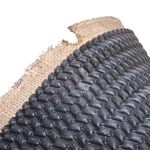
Waffled underlay is made from natural or synthetic rubber which is moulded onto a Hessian backing. When laying, the Hessian backing should face upwards. The process of heat curing gives it a waffle texture, which creates areas for air circulation to minimise dampness and condensation. It is the most expensive type of underlay.
Flat sponge rubber, made from recycled car tyres, has a flat surface and forms a firm and dense underlay that is most suited to commercial applications and domestic level loop (Berber) carpets.
Foam
Prime Polyurethane Foam is made from two liquid ingredients which combine to form a large mass of foam, which is then sliced into sheets.
Bonded Polyurethane Foam is manufactured by binding scraps of chopped foam together into a multicoloured flat pad.
The thickness of foam underlays is measured in millimetres.
Felt
Felt is the original form of underlay, created using up waste textiles and fibres. Today these types of recycled underlays are more often made of synthetic fibres, such as nylon and polyester, to create a dense and firm pad. However, other alternatives are more popular due to their better durability and comfort.
The thickness of felt underlay is measured in millimetres.
Carpet Fixings
There are three methods for fixing carpet to the perimeter of a room;
- Carpet Tacks, where the carpet is folded at the edge and nailed to the wooden floor with tacks every 200mm (8in).
- Double-sided Tape, which is laid around the perimeter of the room, and to which the underside of the carpet is stuck. Note this is only suitable for rubber-backed carpets.
- Gripper Strip. This is the most common method of fixing a carpet as it creates a much neater finish. Gripper strip consists of wood or metal strips that have metal teeth which hold the carpet by biting into the backing material.

A Gripper strip must be laid down around the perimeter of the room with the teeth pointing to the walls. It is usually glued to a concrete floor, and screwed or nailed to wood floor.
Door Bars
Wherever possible, if the same carpet type passes through a doorway, a continuous piece of carpet should be used to avoid visually ‘cutting the floor up’. Where two different floorcoverings are to be used on either side of the doorway, or if a continuous piece of carpet cannot be achieved, a door bar should be used to neatly cover the seam.
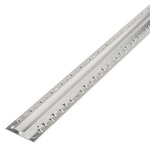
Door bars are available in a variety of finishes and can be used for carpet-to-carpet joins or carpet-to-non-carpet joins.
Door bars should be positioned on the line where the door would be positioned when closed. This ensures that each floorcovering is confined to its appropriate room.
Further information and useful links
- Find a Carpet supplier near you
- Find a Carpet Fitter near you
Site Pages
Featured Articles